Monday, March 31, 2014

Mike McDaniel's "Update 21" — THE WAGES OF SIN


The insightful Mike McDaniel, an experienced former police officer, has written yet another stellar update under "The Erik Scott Case" on his Stately McDaniel Manor website/blog. This piece focuses on the outrageous National Sheriffs Assn.  "award" to Sheriff Dougie-Doo Gillespie:

https://statelymcdanielmanor.wordpress.com/2014/03/30/the-erik-scott-case-update-21-the-wages-of-sin/


"No good deed goes unpunished.”
Attributed to Clare Boothe Luce
In reporting on the murder of Erik Scott by three Las Vegas Metro officers on July 10, 2010, and the resulting cover up, more than the usual share of irony has been evident. It is surely a truism that no good deed goes unpunished, but it is equally true that a great many bad deeds are rewarded.
Corruption rewarded
Corruption rewarded
I recorded an instance of just that on April 17, 2011 in Update 11, which was reprised on 12-03-11 with the shuttering of Confederate Yankee and the establishment of this scruffy little blog.  The National Association of Police Organizations (NAPO) awarded two of the officers that killed Scott–William Mosher and Joshua Stark–“honorable mention” awards for heroism under its “Top Cops” awards program.  In investigating that jaw-droppingly insane award, I discovered that the head of Metro’s union, Chris Collins, was also the Sgt. At Arms of the NAPO. Thomas Mendiola, the other officer that shot Scott, was not so “honored” as he had been recently suspended and was about to be prosecuted for giving a firearm to a convicted felon. He was eventually convicted of that offense and became one of the few Metro officers in recent years to be fired. I wrote:
Nominations for the award require a supporting essay. It would be interesting indeed to know what Collins wrote in support of Mosher and Stark. One wonders if the other directors of the NAPO actually know that the Scott case is still being litigated and that there are considerable, compelling reasons for believing that Mosher and Stark’s actions are anything but laudable.
Collins’ statement that the officer’s shooting of Scott was not controversial and that’“What potentially could have been a bad situation they brought to an end with no citizens being hurt,’ is simply stunning. The facts could hardly be clearer, or more disquieting.
Three officers, essentially comprising a circular firing squad, were caught totally by surprise when Costco security guard Shai Lierley pointed Scott out to them after he and Samantha Sterner walked right past them with the rest of the crowd leaving the Costco at the order of Police. Despite looking for a man of Scott’s description, he was obviously unremarkable to them, and certainly did not appear a drug-crazed madman. When they were made aware of him, they drew their weapons, shouted hasty, confused and contradictory commands, and within just a few seconds, began to fire seven rounds. They showed no concern for or awareness of the many citizens surrounding them, or of the huge structural pillars faced with rock–perfect random ricochet generators–also around them. That no one else was hurt is miraculous, not heroic police work. Stark and Mendiola testified that when Mosher shot Scott twice, they had no idea who had fired or why, so Mendiola fired four rounds into Scott’s back and Stark fired once.
There is very good reason to believe that the only thing in Scott’s hand was his Blackberry. It was found on the ground near his body, and there are witnesses to that fact and who also saw no weapons at all in Scott’s hands or at the scene after he was shot and killed. Most of these witnesses were excluded from the inquest, but one such witness actually testified, to the apparent surprise of the prosecutor, who engaged in the bizarre act of savaging his own witness on the stand in a hearing in which he had no adversary.
Were they aware that Mosher had two prior Metro shootings, one resulting in a death and other in the wounding of a citizen? As I’ve mentioned before, the mere fact that an officer has been involved in a shooting is not evidence of anything other than that he has been involved in a shooting. But officers who have been involved in a shooting are rare in any police force. Two shootings? Highly unusual, and certainly something that should give any police administrator pause and encourage them to be very careful in their investigation of additional shootings by that officer.
One wonders too if the NAPO is aware of Thomas Mendiola and his fate? Despite being later arrested on a felony, he contributed four of the seven heroic bullets to the non-controversial shooting. Should not he share in the “heroism,” heroism that took place before he allegedly committed a felony? After all, heroes are only human; they make mistakes. Surely mistakes after the fact should not stain earlier acts of valor?
One would hope that the officers of the NAPO, if they were actually aware of these indisputable facts, would not have awarded even an honorable mention to Mosher or Stark, and that they might wish to reconsider the integrity of a member of their governing board who would presumably fail to mention such facts. Surely they did not have full disclosure about the shooting and hand out honorable mentions anyway? It would obviously be prudent for such an organization to at least wait until all litigation had been resolved before making a decision. Heroism never grows stale; it has no expiration date. If it’s truly heroic, it can wait.
[NOTE: When this article was originally posted, I contacted the NAPO and sent them a copy of this article.  I did not receive a reply and of course, their award has not been rescinded.]
In Update 11.2, originally posted on May 15, 2011 and reprised at SMM on 12-04-11, I added additional information:
NOTE: At the time, the Metro Union was trying to sneak a bill through the legislature that would have essentially ended inquests in the deaths of citizens at the hands of Metro. He failed; abysmally.
Collins arrogantly announced the award at a legislative committee hearing on a bill that would have allowed the Clark County DA or Coroner–exclusively the Clark County DA or Coroner (in the entire state of Nevada)–to decide whether to hold an inquest in any police shooting. Collins miscalculated. There is substantial evidence to suggest that his ill-conceived action doomed the bill then and there, and has ensured that it has no hope in the future. I’ve come to understand that this kind of arrogant disdain for the public is common with the PPA and with Mr. Collins, and I’ve documented it in past updates.
I sent the following e-mail to the NAPO on April 17:
Sirs:
Good day.  I recently learned that your organization awarded an honorable mention to two Las Vegas Metro officers, Joshua Stark and William Mosher, for their part in the shooting death of Erik Scott in July of 2010.  It appears that your Sergeant-at-Arms, Chris Collins, made the nomination that resulted in that award.
I’d like to bring to your attention information that might cause you to reconsider that choice, and hope that you might consider it seriously.  There is very good reason to believe that their part in the incident for which they are being honored is not worthy of that honor, not the least of which is that it is currently under litigation.
May I suggest that you visit this article:  http://confederateyankee.mu.nu/#314865
It is part of an archive of my writings on this case, which should raise reasonable suspicion about what actually happened.  Did you know, for example, that one of the three officers who shot and killed Erik Scott was, only months later, arrested for giving a firearm to a felon?  Did you know that Off. Mosher, prior to the Scott shooting, had been involved, in a short time, in two shootings, one resulting in the death of a citizen and one a wounding?
As a veteran of nearly two decades of police service, I urge you to carefully consider this situation.  I suspect that you’ll find, as have I, that at the very least, it would be unwise to pronounce these officers heroic, unwise and damaging to the reputation of your organization. There are more than enough examples of undisputed, unblemished police heroism out there.
I suspect that it will not be a surprise to readers to learn that the NAPO has not responded [NOTE: It never responded] and that as of the posting of this article, Officers Mosher and Stark are yet listed as honorees on the NAPO website. As I mentioned in my e-mail, this ‘honor’ would seem to be, at the very least, premature. That the NAPO would issue such an honor under these conditions does not speak well of its integrity and dedication to recognizing and rewarding actual heroism and excellence.
In all of my years in law enforcement, I often saw people richly deserving of recognition passed over and ignored, and people whose only accomplishment was posterior bussing lauded. I’ve seen the same in education, and doubtless, readers can relate many similar situations in every field of human endeavor.  However, before the Scott case, never had I seen two officers arguably guilty of murder, and of employing such horrible tactics that they put the lives of hundreds of citizens in imminent deadly danger, rewarded for their blatant incompetence.
Las Vegas Metropolitan Police Department Sheriff Douglas C. Gillespie was named by the National Sheriffs’ Association as the winner of the prestigious Ferris E. Lucas Award for Sheriff of the Year 2014.
Of the 3,080 sheriffs in the country, the award has only been given to 18 people since 1995.
The award will be presented to Sheriff Gillespie on June 22 during the opening portion of the 2014 NSA Annual Conference in Ft. Worth, Texas.
Gillespie, a 33-year LVMPD veteran, was elected in 2007 and leads more than 4,700 sworn officers and civilian employees. He is responsible to the safety of nearly 2 million residents and 40 million visitors a year.
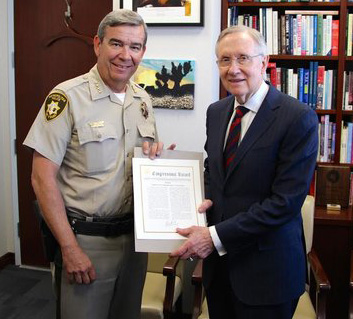
On Thursday, Senator Harry Reid presented Sheriff Doug Gillespie with a Congressional Proclamation for being selected Sheriff of the Year.
This presentation took place in Senator Reid’s office located in the Lloyd George Federal Building.
We are pleased to announce that Douglas C. Gillespie, Sheriff of Clark County, Nevada has been selected as the 2014 Ferris E. Lucas Award for Sheriff of the Year.
Sheriff Gillespie is currently serving his second term as Sheriff of Clark County. He worked his way up trough the ranks at the Las Vegas Metropolitan Police Department and was elected Sheriff in 2007. Sheriff Gillespie is a 30-year law enforcement veteran. During this time, Sheriff Gillespie has been an active member of his State Association and has contributed greatly to the law enforcement endeavors of his county and the State of Nevada.
Sheriff Gillespie is the Sheriff of the Year, a man that presides over a police department notorious for an extraordinary number of highly questionable police shootings–and killings–each year. Among his accomplishments is poorly training his officers, and hiring and retaining obviously dangerous cops, cops who not only abuse and beat citizens, but actually kill them.  In the hundreds of police shootings in recent years, only one officer has ever been found culpable and fired, and few have suffered any discipline.  It has only been the adverse publicity that the Scott case, and several others, has focused on Metro and Gillespie, that has caused him to discipline, even fire, some particularly notorious officers, such as Derek Collings, as I reported in Update 10.2. and Jesus Arevalo.
When the Metro union boss, Collins, threatened that any officer subpoenaed to testify at an inquest would take the Fifth, Sheriff Gillespie did nothing. In a professional agency, no officer would so much as think of saying such a thing.  The mere idea that any officer would take the Fifth Amendment on the stand in testifying about his official actions would be unthinkable.  It would destroy public confidence in law enforcement, such confidence being very scarce in Las Vegas.  Not in Gillespie’s Metro; the unthinkable is policy.
Those familiar with the Scott case know the depth of the cover up: mishandling of evidence, tampering with and intimidation of witnesses, illegally searching Scott’s home and seizing his property–to say nothing of his murder–and the list of malpractice and potential crimes goes on and on.  The SMM Scott Case archive is here.
Gillespie’s corrupt support of arguably murderous officers continues to this day, as in the more recent case of Officer Jacquar Roston, who shot an unarmed, unthreatening man in the leg in November of 2012.  Roston claimed that he mistook something shiny on the man’s hat for a gun. The man was very seriously wounded, and if not for Roston’s poor marksmanship, would have been killed.
Robert Martinez was skeptical when Metropolitan Police Department leaders asked for help to revamp a review board known more for rubber-stamping police shootings than holding cops accountable.
But he was hopeful.
Martinez, 57, agreed to join the board last year as the civilian co-chairman, serving alongside Assistant Sheriff Ted Moody, who was appointed by Clark County Sheriff Doug Gillespie to oversee the renewed board.
Martinez also had a caveat, which he shared with Moody and other department leaders early in the process.
‘The first sign of no transparency and no openness, and I’m calling bullshit,’ he said.
It didn’t take long for Martinez, and other board members, to make that call:
Martinez quit the board Wednesday. He was joined by four other board members: Glenn Rinehimer, Sandra Eddy, Jay Shafritz and Miriam Rodriguez.
Their resignations followed Moody’s abrupt retirement last week. Gillespie appointed Assistant Sheriff Joseph Lombardo on Wednesday to replace Moody as chairman of the board, which reviews officers’ actions in shootings and other serious uses of force.
The five members, all volunteers, were disappointed in Gillespie’s decision to save officer Jacquar Roston’s job after the Use of Force Board unanimously recommended his firing in April.
‘I am saddened by what I feel is your inability to maintain the integrity and credibility of the Critical Incident Review Process,’ Martinez wrote in his letter. ‘I can no longer support the department’s consistent effort to minimize openness and transparency.’
Shafritz, a three-year veteran of the board, told Gillespie he no longer could serve ‘in good conscience.
The article chronicles the comments of other board members.  This should be no surprise.  As I’ve previously documented in the Scott Case series of articles, Gillespie’s review board has long been known as a farce and rubber stamp, allowing the most violent, incompetent and dangerous officers to escape all but the most minimal discipline.
In Roston’s case, Gillespie applied only a weeklong suspension and said Roston would undergo unspecified “retraining.”
The changes to the Use of Force Board came in the wake of a federal review into the department’s use-of-force policies and publication of a Review-Journal series, “Deadly Force,’ a yearlong investigation of police shootings. Both the Justice Department and the newspaper found the board lacked transparency and didn’t hold officers accountable.
That was an understatement.  Readers interested in Metro’s deadly past might wish to review Update 18, where I reviewed the Las Vegas Review Journal’s five-part series on Metro’s extraordinary number of police shootings.  Reviewing all of the articles linked in this article would also be instructive, as would this article which explains, in part, why Gillespie is not running for sheriff again as he originally planned.
Shortly after Martinez’s resignation, a sixth board member followed: 
Robert Le Piere, 60, resigned as a civilian board member Thursday morning, following in the footsteps of the five board members who resigned the day before.
On Wednesday, board co-chairman Robert Martinez and four members quit in protest of Clark County Sheriff Doug Gillespie’s decision to save the job of Jacquar Roston, who shot and wounded a man in November. The board unanimously recommended Roston be fired.
Assistant Sheriff Ted Moody, who co-chaired the board, abruptly retired last week after Gillespie’s decision.
Le Piere, a retired police officer from New Jersey and six-year veteran of the board, said he wasn’t on the panel that reviewed Roston’s shooting but was troubled by Gillespie’s ruling.
‘I have never been on a panel where people took it anything less than tremendously serious,’ Le Piere said. ‘I can understand their feelings having their decision overturned. It’s offensive. Why are we here?
Why indeed.
Pandering to a police union to the detriment of the public, hiring and retaining officers demonstrably unfit and actively dangerous to the public, running a police department whose officers are hated and feared by the citizens they “serve,” and with more than good cause, running a civilian review board as a rubber stamp for indefensible decisions, and ignoring them when they unanimously recommend firing an officer that would have been fired by any professional chief or Sheriff, all of this and more is apparently worthy of high honors in law enforcement in 2014 America. For the NSA, Doug Gillespie is apparently the pinnacle of law enforcement integrity and accomplishment.
In Las Vegas, it’s merely the status quo, what residents have come to expect.  God help them; the NSA and Metro won’t.
PS: I’ll contact the NSA and report on what, if anything, they have to say about this.  Readers can contact the NSA via e-mail here.  I would, of course, be interested in copies of any correspondence to and from the NSA.  I’m sure SMM readers will maintain their usual decorum in their writings to the NSA.


Sunday, March 2, 2014

"Read an E-Book Week" - 50% off Coupon for "The Permit"


An E-book version of "The Permit" is available at 50% off during Smashwords' "Read an E-Book Week." Use code REW50 at checkout to download a copy for Kindle, iPad, Nook or your computer and get a 50% discount through March 8th.

 Smashwords.com/books/view/266906


Wednesday, July 31, 2013

STARVE THE BEAST


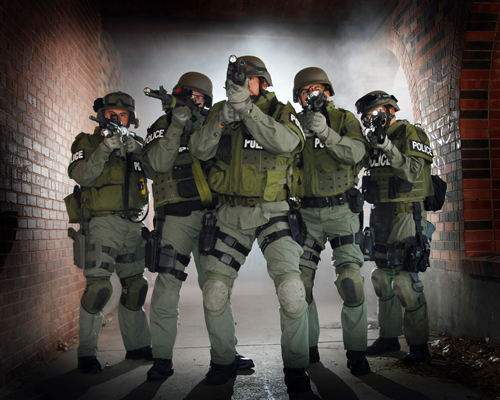
Militarizing U.S. Law Enforcement

1
By Rachel Ehrenfeld, William Scott
Wednesday, July 31st, 2013 @ 2:29AM
Print Friendly
Introduction:
The growing militarization of U.S. law enforcement agencies does not necessarily help to protect Americans in their homeland. Increasing the number of heavily armed uniformed policemen who abuse their power and even shoot to death innocent citizens is becoming a cause for concern. ACD Senior Fellow William B. Scott questions the increased use of SWAT teams.
Starve the Beast
By William B. Scott*
In an excellent July 19, 2013, Wall Street Journal essay entitled “Rise of the Warrior Cop,” author-journalist Radley Balko described the alarming militarization of police forces across America. He cited myriad cases of innocent citizens being killed by over-zealous police officers, particularly Special Weapons and Tactics (SWAT) teams serving warrants for alleged, often petty, offenses.
The WSJ essay, which is based on Balko’s newly released book, “Rise of the Warrior Cop: The Militarization of America’s Police Forces,” details several egregious cases, where gunned-up, overzealous SWAT forces executed citizens in the name of enforcing gambling laws and mere regulations. “In 2006,” the author writes, “38-year-old optometrist Sal Culosi was shot and killed by a Fairfax County, VA, SWAT officer,” after an undercover detective overheard Culosi betting on college football games. “The department sent a SWAT team after Mr. Culosi, who had no prior criminal record or any history of violence. As the SWAT team descended, one officer fired a single bullet that pierced Mr. Culosi’s heart. The police say that the shot was an accident.”
That tragedy was hardly an exception. Today, elite police units often break into the wrong houses and kill innocent “civilians,” as cops now refer to citizens, the same people who pay officers’ salaries. The response given to families, friends and communities traumatized by such senseless killings? “So sorry. Just a mistake. Move on now; nothing to see here.”
Balko notes that “longtime and retired law-enforcement officers have told me of their worry that the trend toward [police] militarization is too far gone.” He offers a number of potential courses to reverse this slide to a Soviet-style, oppressive state, including “community policing” and “ending the federal grants that encourage police forces to acquire gear that is more appropriate for the battlefield” than protecting and serving honest taxpayers.
Nothing would be faster or more effective than the latter: Curtailing funds that have enabled the explosive growth of an aggressive, above-the-law police culture across the nation. Elected officials should immediately cut off federal money being funneled to local police departments.
Balko noted that the U.S. Department of Homeland Security has given “first responders” $35 billion in grants, since the agency’s creation in 2002, according to the Center for Investigative Reporting. Much of that was used to buy military hardware, such as armored vehicles. When U.S. combat units are being disbanded and front-line fighter aircraft grounded for lack of funding, there’s absolutely no justification for giving high-powered automatic weapons, night vision goggles and armored vehicles to thousands of burgs across America. If cities truly need SWAT teams, local residents should pay for them. Eliminate federal bucks and thousands of SWAT units will simply be dissolved, because there’s no need for them.
Equally effective would be the immediate banning of “No Knock” practices, which have claimed countless lives. When heavily armed, black-uniformed officers break into a home, often in the dead of night, how is the owner supposed to determine that those cops aren’t criminal invaders bent on harm? More often than not, an innocent homeowner, trying to protect himself and his loved ones, is killed-despite doing nothing that warranted being shot to death.
Federal, state and local officials also would be well-advised to start listening to outraged citizens, rather than self-serving police unions. Anger is sweeping the nation, thanks to an epidemic of abhorrent, heinous abuses and killings, typically by young, inadequately screened and poorly trained police officers.
For example, more than 30 California families of police-shooting victims marched through Anaheim on July 21 to protest the killing of loved ones. The Austin, Texas-based Peaceful Streets Project, which was founded by a former Army Ranger falsely accused of spitting on a police officer, has expanded at warp speed, with chapters popping up across the country. PSP members routinely follow police officers and video-record their actions. Although unlawful practices are showcased via YouTube, where millions now watch video clips of uniformed officers harassing, beating, abusing and brutalizing citizens, Peaceful Streets members are just as quick to applaud, when an honorable cop does the right thing.
Another asymmetric-warfare tool for exposing bad police behavior is a new genre of novels called “Justice Through Fiction.” By wrapping an intriguing story around the facts of illegal activities and senseless murders committed by law enforcement officers, authors are leveraging the considerable power of fiction and entertainment (books, movies, TV shows, etc.) to lay bare the dark misdeeds of today’s malevolent, rogue cops. Novels and movies also are delivering a thinly veiled warning to honorable officers and every police chief and sheriff: Either clean up your departments, by getting rid of uniformed thugs and killers, or outside forces will.
Americans and their elected leaders are reluctant to accept the truth that a minority within largely professional police forces are routinely abusing and killing innocent citizens, then blatantly lying to protect their own tails. But every taxpayer, community leader and law enforcement official had better wake up and start holding rogue cops accountable for their crimes. Millions are fed up with officialdom blindly accepting sloppy cover-up “investigations” and winking at abuses via courtroom farces structured to ensure killer-cops are routinely exonerated.
And the natives are ready to revolt. That sounds far-fetched, but it’s a fact-and it’s imminent. Unless victims are assured of justice, with killer-cops indicted, prosecuted and imprisoned, today’s pandemic of police officer abuse of authority willspark a violent, bloody backlash. Aggressive, imperious police departments that behave like terrorists must be gutted, revamped and restored to a protect-and-serve culture, or cops will become hunted prey. That’s a one-way road to anarchy, and no American wants to go there.
The first step is to cut off funding for unnecessary SWAT units and any department having a record of corruption, abuse and murders-by-cop. Starve the militarized-police beast, and the monster will die with nary a whimper.
* William B. Scott, a Senior Fellow at ACD, is a former aerospace journalist and author of “The Permit,” a techno-thriller novel based on actual events associated with the murder of his eldest son, a successful businessman, decorated ex-Army officer, and West Point graduate with an MBA from Duke University.
http://acdemocracy.org/militarizing-u-s-law-enforcement/#sthash.ABlKp1c9.dpuf

Tuesday, July 23, 2013

Discussion of "The Permit" and Erik's case on Jon Ralston show


On July 10, the third anniversary of my son's murder in Las Vegas, NV, Jon Ralston of Channel 3/KSNV kindly invited me on his "Face-to-Face" show to talk about Erik and "The Permit." Here's a link to that discussion (may have to scroll down to the July 10, 2013, show):

http://www.mynews3.com/content/programming/local/facetoface/default.aspx

During the interview, I identified "Captain Cover-Up" as LVMPD Captain Patrick Neville. This Las Vegas Metro police officer was the architect of a sloppy, transparent cover-up of Erik's murder-by-Mosher. At the time, Neville headed Metro's Homicide unit, but has since returned to his comfort zone, Metro Intel. I wonder why.

I also revealed the fact that a "double" of Erik was in Costco on that fateful day, July 10, 2010. Mr. Double bore a striking resemblance to Erik—same height and almost the same weight, hair color and eye color. And that man WAS impaired; he was either drunk or under the influence. Mr. Double was the guy Costco employees reported stumbling and falling on the checkout conveyor belt. "Double" also caused some kind of loud disturbance at the Costco pharmacy. (We have a photocopy of "Double's" driver's license, but, for his protection, we're not revealing his identity and address.)

Later, when an employee saw Erik carrying a legal concealed weapon, Shai Lierley, Costco's malicious undercover loss-prevention officer, gleefully called the cops. Did he believe Erik and Mr. Double were the same guy? That the man, who caused a ruckus at the pharmacy, and "the big redhead with a gun" were the same person? Possibly, because the two men could have passed for brothers.

Later, after Erik was shot to death, Costco employees were herded into a room and TOLD what they should report to police investigators. Several employees were subsequently briefed on what to say at the farce of a coroner's inquest hearing into Erik's murder-by-cop. There was no mention of "Mr. Double," of course.

Interestingly, every Costco employee testifying at the "inquisition" described Erik as 5' 8" tall and accompanied by a SHORT woman, who had long, dark hair and was wearing a WHITE top.

In contrast, Erik stood 6' 0" tall and was accompanied by a girlfriend, who was very tall (almost six feet, in heels), had long, dark hair and was wearing a DARK-colored top. Tellingly, one Costco employee, who testified at the inquest hearing, said pictures of Erik "were a lot better-looking than the man I saw" in the store that July 10th. That's because she saw Mr. Double fall on the checkout conveyor belt, not Erik Scott.

Without question, Costco managers intimidated their employees. Either the latter willingly spouted falsehoods dictated by their managers, or the employees' jobs were in jeopardy.

When I was writing "The Permit," our attorneys barred me from including anything about "Mr. Double." That restriction was lifted prior to the launch of "The Permit" in hardcopy/paperback earlier this month.

More revelations to follow.... Meanwhile, the hardcopy version of "Permit" is now available at Amazon and PygmyBooks.

—William B. Scott

Tuesday, April 9, 2013

Stop Exaggerating the Threat to Cops


As stated in "The Permit," cops are safer today than since the 1960s, but arrogant, selfish police unions and a lazy, complicit media's reporters continue to justify and excuse killer-cops' behavior by citing dangers to officers. A terrific writer, Radley Balko, documents the overt lies being promulgated by these self-interests in a new blog posting that sets the record straight.  — William B. Scott

April 9, 2013
Why We Need To Stop Exaggerating The Threat To Cops

The Huffington Post  |  By Radley Balko
Posted: 04/09/2013 1:19 pm EDT  |  Updated: 04/09/2013 4:23 pm EDT

The recent killings of two prosecutors in Texas, a Colorado Department of Corrections official and a sheriff in West Virginia have law enforcement groups and the media once again buzzing about an alleged "war on cops" or, in some instances, a broader trend toward violent anti-government sentiment. Over at The Atlantic, Philip Bump does a good job debunking that idea. (He also quotes me.)

Unfortunately, thorough and skeptical analyses of police fatality statistics like Bump's are rare. The "war on cops" talk heats up every time that one or more high-profile police killings hit the news. But there's just no evidence that it's true.

I've pointed out a number of times that the job of police officer has been getting progressively safer for a generation. Last year was the safest year for cops since the early 1960s. And it isn't just because the police are carrying bigger guns or have better armor. Assaults on police officers have been dropping over the same period. Which means that not only are fewer cops getting killed on the job, people in general are less inclined to try to hurt them. Yes, working as a police officer is still more dangerous than, say, working as a journalist. (Or at least a journalist here in the U.S.) But a cop today is about as likely to be murdered on the job as someone who merely resides in about half of the country's 75 largest cities.

You can read the linked pieces above for more evidence that police officers today are as safe as they've been in decades. But I want to discuss why it's important to push back against this "war on cops" narrative.

It should go without saying, though I will: This has nothing to do with trying to diminish the tough job that police officers do or to cast aspersions on those who have been killed. But there are other reasons why journalists need to do a better job of reporting this story accurately. (Beyond the hopefully obvious value of reporting things accurately for the sake of reporting them accurately.)

For example, one effect of false perceptions about the dangers of policing that I've noted before is that they can sway public debate on issues like police budgets, police use of force, police militarization and what sort of accountability cops should face when they're accused of violating someone's civil rights. Exaggerating the threat that cops face can make policymakers and public officials more reluctant to hold bad cops accountable or more willing to outfit police departments with weapons and equipment better suited for warfare.

This would explain why police groups tend to perpetuate the myth. But why does the media credulously report their narrative? Part of it is probably just laziness -- a lack of will or interest in seeing whether the claims are backed up by any data. The "war on cops" meme also fits the "if it bleeds, it leads" idea. "While this officer's murder is tragic, generally speaking, law enforcement officers are safer on the job today than they've been in 50 years" just isn't as interesting as "This may be part of a growing trend of cop killing."

Much of the media also appear to be infatuated with the idea that we're in the midst of a dramatic rise in anti-government, anti-authority, pro-militia, right-wing, white nationalist -- pick your extremism -- violence in America, despite plenty of evidence to the contrary. (Just last weekend the Los Angeles Times ran a front-page report on the "sovereign citizen" movement, a group that authorities say is responsible for six deaths in 12 years.) In the interest of fairness -- or some might say false equivalence -- I'll note the conservative media seem just as enamored with the idea of a growing threat of violence from Muslim extremists and environmental radicals, again despite plenty of evidence to the contrary.

But there's a more pernicious effect of exaggerating the threat to police officers. In researching my forthcoming book, I interviewed lots of police officers, police administrators, criminologists and others connected to the field of law enforcement. There was a consensus among these people that constantly telling cops how dangerous their jobs are is affecting their mindset. It reinforces the soldier mentality already relentlessly drummed into cops' heads by politicians' habit of declaring "war" on things. Browse the online bulletin boards at sites like PoliceOne (where users must be credentialed law enforcement to comment), and you'll see a lot of hostility toward everyone who isn't in law enforcement, as well as various versions of the sentiment "I'll do whatever I need to get home safe at night." That's a mantra that speaks more to self-preservation than public service.

When cops are told that every day on the job could be their last, that every morning they say goodbye to their families could be the last time they see their kids, that everyone they encounter is someone who could possibly kill them, it isn't difficult to see how they might start to see the people they serve as an enemy. Again, in truth, the average cop has no more reason to see the people he interacts with day to day as a threat to his safety than does the average resident of St. Louis or Los Angeles or Nashville, where I live.

Last week I had lunch with a certified expert in police use of force -- a guy who teaches classes to police about how and when to use force, how much to use, and under what circumstances. I'm fairly cynical, and I've just written a book that covers much of this ground, but I was still surprised by what he told me. In too many use-of-force classes, he said, cops aren't taught about appropriate vs. inappropriate force so much as they're taught what to say and do to justify whatever force they've already used. In other words, the courses aren't about training, they're about ass-covering. Today, these courses stress officer safety above all else -- including the civil and constitutional rights and the safety of the citizens the police are supposed to be serving. They teach cops to use more force, sooner, more often, and how to justify it after the fact.

The Force Science Institute, for example, trains law enforcement officials in how to investigate allegations of excessive force. But browse the archives of the organization's newsletter and you'll mostly see articles justifying the use of Tasers and questioning claims that they cause injury or death; justifying (or at least mitigating the criticism of) police use of force in even egregious, high-profile incidents (such as the 2009 Oscar Grant shooting); and promoting junk science explanations of in-custody deaths like "excited delirium." You'll have a much more difficult time finding articles about how to de-escalate volatile situations or how to create a police culture that emphasizes dealing with difficult subjects without using force -- or at least with the minimum amount of force possible. This is a group that certifies investigators of police shootings, police use of stun guns and other allegations made against cops, and their educational materials show a strong bias toward highlighting research that justifies force.

Back in 2008, a SWAT team in Lima, Ohio, raided the home of a suspected drug dealer. During the raid, one SWAT officer perfunctorily shot and killed the suspect's dogs. As he did, another officer was ascending a flight of steps in the home. That officer mistook his colleague's gunfire for hostile fire and, seeing some shadows coming out of an upstairs bedroom, he opened fire into that room. Inside was 26-year-old Tarika Wilson. She was on her knees, as she'd been instructed. She had one arm in the air and the other holding her year-old son. Wilson was killed. Her son lost a hand.

Officer Joseph Chavalia was charged with manslaughter (a pretty rare thing in these cases). At his trial, one use-of-force expert -- someone who trains police officers on when it's appropriate to use force -- actually testified that not only had Chavalia not done anything wrong, but if anything he was too slow to fire on the unarmed woman and her child. (Chavalia was acquitted.) This is the training too many police officers get today -- shoot first, worry about what you're shooting at later.

All else being equal, we should certainly strive to keep police officers as safe as possible. But cops assume a risk when they sign up for the job. That risk involves putting the safety of others above their own. That's kind of the whole point of having law enforcement officers in the first place. Many of the older cops I interviewed for the book told me that sense of sacrifice -- really the public service aspect of the job -- has been lost over the last few decades.

Of course, there are other factors that have contributed to the psychological isolation of police. One example is the move from foot patrols to squad cars or, more broadly, from proactive to reactive policing. When cops walk beats, they become a part of the communities they patrol. Residents see them out and about. They learn names, faces and places. When police patrol in cruisers, they're walled off from neighborhoods. Most of their interactions with the public on a typical day will be the result of conflict or confrontation. Imagine a job where nearly all of your interactions with other people are negative -- you're either confronting someone you suspect has done something wrong, dealing with a volatile domestic dispute, or responding to a complaint about a crime, most always after that crime has been committed. No matter what your job, if most of your interactions with other people are negative, it's going to make for a pretty miserable existence. Now add a baton, a gun, a Taser, and the authority to use force.

So we have cops whose interactions with the public are negative the vast majority of the time, who are constantly told they're fighting a war, and who are constantly reminded that their job is highly dangerous and getting more dangerous, and that they could be killed by anyone at any time. When they start to see the people they serve as the enemy, they begin to treat them that way. The people in the communities treated that way then respond in kind. Thus, we get the hostile, often volatile cop-community relationships we see in too much of the country today, in which citizens don't trust cops enough to help them solve crimes, and cops feel so threatened and isolated that even well-meaning officers won't report fellow officers who break the law.

The fact that cops are safer today than they've been in a half century is great news. It should be big news. It's something we ought to be celebrating. Reporting that and challenging -- or at least attempting to verify -- opposing pronouncements from law enforcement groups would not only be getting the story right; it would help with the problem of cops who see people as the threat and their jobs as a mere quest for survival.

Monday, April 1, 2013

"The Permit" - PR Web News Release


 Contact: Lisa Mayo-DeRiso
                Mayo & Associates
                702.576.2659
                mayoderiso@aol.com

                                                                                    FOR IMMEDIATE RELEASE


THE PERMIT

 Techno-Thriller Unveils the Most Dangerous
Domestic-Terrorism Threat Facing America Today

Written By William B. Scott and Inspired by the real-life murder
 of his son, Erik Scott, By Las Vegas Police

LAS VEGAS (March 28, 2013) – The murder of a beloved son, a quest for truth and justice usurped by a broken legal system, and a battle with both grief and a blatant cover-up, led author William B. Scott to create a fictional tale rooted in every parent’s nightmare. The result is The Permit, a compelling techno-thriller novel based on the real-world murder of Erik Scott, who was gunned down by Las Vegas Metropolitan Police Department officers in front of a suburban Costco store in July 2010.

“My son, Erik, was murdered, because a BlackBerry in his hand was mistaken for a firearm. That senseless tragedy was magnified by a sloppy, transparent cover-up orchestrated to protect his killers and a Cartel of Corruption that controls Las Vegas,” said William B. Scott, bestselling author and Erik Scott’s father.  “It soon became apparent that the Cartel’s enforcers—rogue cops—were no different than dangerous domestic terrorists. In the past, rogue cops were a very small percentage of U.S. police forces. But that changed in recent years. Today, twenty-five-to-thirty percent of some police departments—including Las Vegas Metro—comprise ‘rogue’ or ‘bad’ cops. Every day brings another headline about American citizens being brutalized and killed by those who have sworn to serve and protect.”

-more-
The Permit recounts a dramatic “black operation” that launches in Las Vegas, Nevada, when Department of Homeland Security intelligence agents identify a new, incredibly dangerous terrorist “sleeper cell.” This group constitutes the most serious domestic-terrorism threat to national security the U.S. has faced since nine-eleven. In the past decade, it has killed more Americans than al Qaeda murdered on nine-eleven. These terrorists are deeply entrenched in our society. They look like us, talk like us, live in our neighborhoods and, for the most part, pass for respected citizens. But they are killing thousands of Americans throughout this great country—and becoming more militant and powerful every day. Their code name is INDIGO. Checkmate, a covert counterterrorism team, has the advanced-technology weapons and agents to neutralize INDIGO, but very little time to do so. If Checkmate fails, America will erupt in armed rebellion.

Why fiction? “When it became apparent that the traditional ‘legal’ process was failing my family,” Scott explained, “I turned to an effective asymmetric-warfare vehicle for revealing truth: entertainment. A story that blended fact and fiction would expose the Las Vegas Cartel of Corruption by showcasing its brutal methods and warped, venal objectives. It’s a proven tool called ‘Justice through Fiction.’”

Enthusiastic advance praise for The Permit, a fast-moving, high-tech thriller that sets a new benchmark for “Justice through Fiction:”

“With The Permit, Scott has taken personal tragedy and fashioned it into a work of art. He has expertly woven a complex story of intrigue into the thinly veiled account of his son, Erik's, 2010 Las Vegas ‘murder-by-cop.’ A heartbreaking tale, you can feel the love between the lines, but Scott never overdoes it with sentimentality, instead taking revenge by writing against the terrible injustices that befell his family. I…am awed that he was able to turn tragedy into triumph, which is just another example of his skill as a writer. A real page-turner.”  - Cathy Brown, Brooklyn, NY

-more-
" The Permit is one of those books that, once you start reading, you can't put it down. The excitement and intrigue of political and police corruption, the crime syndicate, high-tech ‘black world’ operations, and personal ambitions, all intermixed and centered around the murder of a young man, as he walked out of a ‘big box’ store with his fiancĂ©e, is skillfully crafted into a gripping, highly recommended book.” — R. Vondra

“Writing The Permit was also a way of grieving—my route to healing,” Scott added. “By blending fact and fiction, Permit lets readers experience a dad’s range of emotions, from crushing grief, anger and frustration to the satisfaction of seeing justice ultimately delivered by a covert government agency employing cutting-edge ‘black world,’ high-tech weapons.”

The Permit launches a series of techno-thriller novels built on a unique theme: “Fiction as a Legal Weapon.”    

The Permit is available now as an e-book at iBookstoreAmazon.comSmashwords.com, and BarnesandNoble.com.

About William B. Scott
William B. (Bill) Scott is a full-time author. A former flight test engineer and aerospace journalist, he retired as the Rocky Mountain Bureau Chief for Aviation Week & Space Technology, following a 22-year career with the international magazine. He and his wife live in Colorado Springs, writing and developing the “Fiction as a Legal Weapon” brand of techno-thrillers derived from a premise established in The Permit.